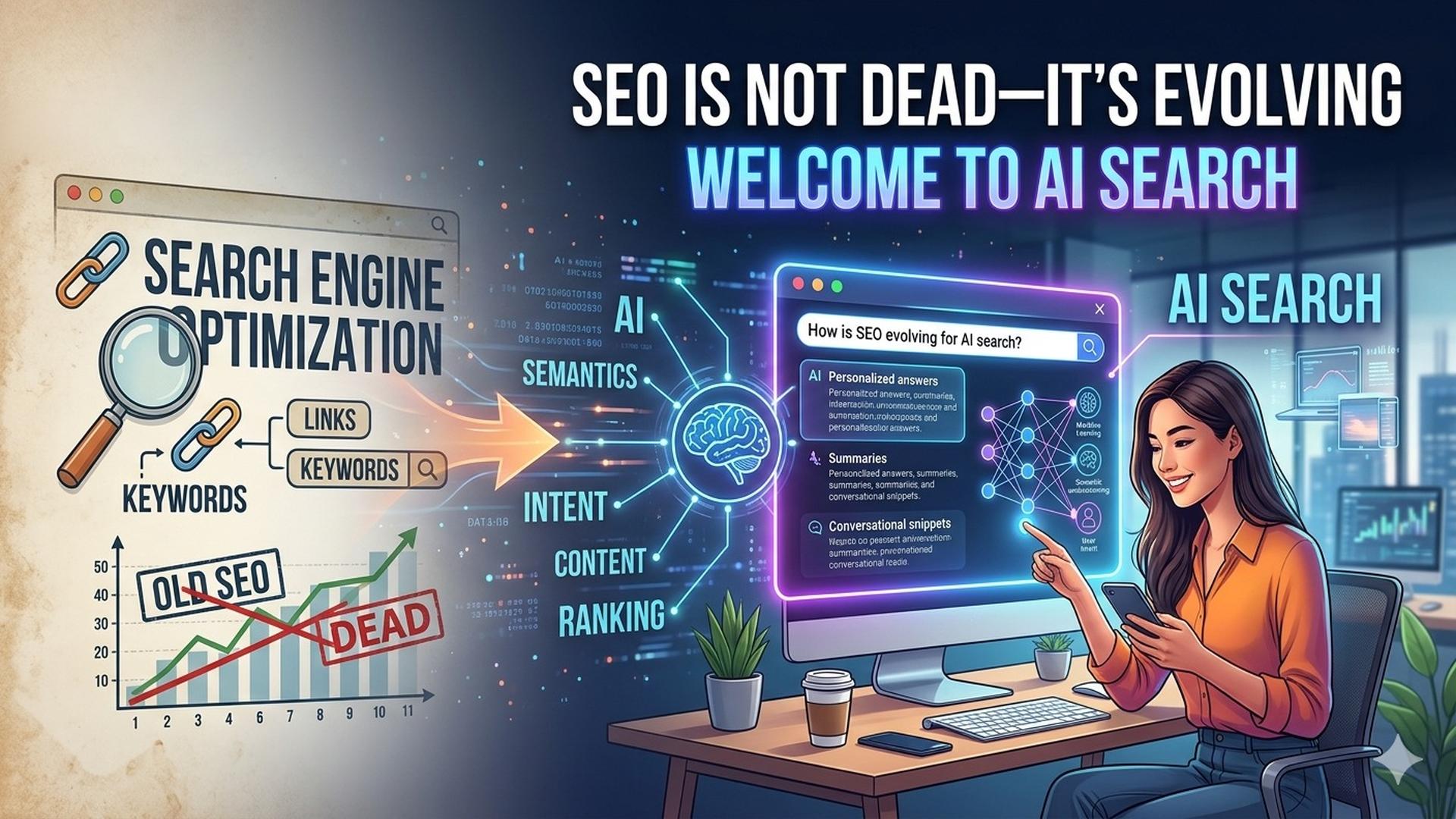
Every moving year in the digital marketing industry, people have repeated the same prediction after every major algorithm update: “SEO is dead.” In 2026, SEO continues to drive visibility, traffic, authority, and business growth across various industries.
Initially, people searched using phrases like "best project management software."
Now people search with intent like, “Which project management tool is best for a remote startup team with under 20 employees?”
Thus, we can see the rules of digital visibility have shifted toward conversational and intent-driven search.
How we did traditional SEO heavily focused on keyword optimization, backlinks, technical performance, and ranking positions. Although these factors still matter, they are no longer enough on their own. Thus, nowadays, businesses must optimize not only for search engines but also for AI-powered answer systems and generative search platforms.
That is where the evaluation in the search system introduced SEO, AEO, and GEO. All three work together to provide solutions to the new age internet user.
The new search ecosystem now includes SEO, AEO, and GEO.
SEO (Search Engine Optimization)
The traditional SEO still remains the foundation of online discoverability as it helps websites rank higher on traditional search engine results pages through the following:
- Keywords
- Technical optimization
- Backlinks
- Site authority
- Content relevance
The primary goal of SEO has always been to “get the click." However, AI-driven search behavior is changing that journey.
What is AEO (Answer Engine Optimization)?
AEO, or Answer Engine Optimization, focuses on structuring content so it appears as a direct answer within AI-powered search experiences, such as
- Google AI Overviews
- Featured snippets
- Voice assistants
- People Also Ask results
- Bing Copilot
With the help of AEO, users may receive the information instantly without even visiting the website.
In simple terms, SEO helps you rank, and AEO helps you become the answer for internet surfers.
Introducing GEO (Generative Engine Optimization):
The next evolution is GEO, or Generative Engine Optimization, which focuses on helping AI systems like ChatGPT, Gemini, Claude, and Perplexity identify, trust, synthesize, and cite your content while generating responses.
Unlike traditional SEO, GEO prioritizes the following:
- Entity authority
- Trust signals
- Expert-led insights
- Structured information
- Information gain
- Credible citations
Now it's no longer about simply appearing on a search page, but it is about becoming part of the AI-generated conversation itself.
SEO Is Evolving—Not Disappearing
Many businesses still believe ranking #1 on Google guarantees visibility. But in the AI search era, that is no longer always helpful.
A brand may dominate traditional rankings and still struggle to appear on AI-generated answers. That is why SEO, AEO, and GEO are not competing strategies. They are layered strategies that work together for a brand to appear in AI-generated search results aligned with the search intent.
SEO is not dead! Together, SEO builds discoverability, where AEO increases answer visibility, and GEO strengthens AI authority.
The future of search belongs to brands creating trustworthy, experience-driven, and genuinely helpful content for both humans and AI systems.